

A Decade to Act: Why Short-Term Carbon Removal Shouldn’t Be a Dirty Word
April, 2026What if our obsession with 1,000-year carbon removal is causing us to overlook the solutions that can make the biggest impact in the next 10 years? And in a decade defined by climate urgency, can we afford to ignore tools that are ready to scale today? Biochar maven, Kathleen Draper, outlines why biochar deserves renewed attention as a scalable, near-term solution in the carbon removal mix.
Ask anyone in the carbon removal (CDR) space what “counts,” and you’ll often hear the same refrain: durability. The gold standard, we’re told, is removing carbon for 1,000 years or more. Technologies that can’t meet that bar, even if they remove carbon today, are sometimes dismissed as inferior.
But what if this mindset is holding us back?
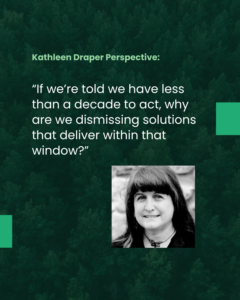
“I’ve been in conversations where a decade of carbon storage is seen as irrelevant,” says Kathleen Draper, an Emeritus Board Chair of the International Biochar Initiative. “To me, that’s a dangerous form of single-mindedness.”
As climate risk intensifies, so does the need to rethink our expectations and our timeframes. If we’re serious about averting planetary tipping points, we need a both/and mindset: long-term removals and scalable, near-term solutions. In that mix, biochar deserves a second look.
Why the 10-year window matters
The next 10 years will be decisive for global climate action. According to the Intergovernmental Panel on Climate Change (IPCC), emissions must fall nearly in half by 2030 to stay within 1.5°C warming. Yet most durable carbon removal pathways, from direct air capture to enhanced weathering, remain expensive, energy-intensive, or still in pilot phases.
Meanwhile, biochar is being produced and applied today. It removes carbon from the short-term cycle, and while its durability depends on multiple factors (feedstock, temperature, use case, etc.), at a minimum, it often lasts decades to centuries, with meaningful climate impact in the near term. And there are no technology limitations that prevent it from scaling immediately.
Reframing ‘durability’ with practicality
The term durability implies a binary, as if carbon is either locked up for millennia or not at all. But in reality, it’s a spectrum. Biochar often sequesters 50–80% of original carbon for 100+ years in the right conditions, especially when integrated into infrastructure or soils protected from disturbance.
But even when biochar stores carbon for “just” 10–50 years, the benefits can be significant, especially when paired with co-benefits like:
- Soil regeneration, crop resilience, and accelerated drawdown
- Heavy metal immobilization in contaminated sites
- Improved water retention in drought-prone landscapes
- Thermal buffering in building materials or pipeline infrastructure
We don’t wait for perfect in other sectors
In public health, we don’t delay vaccines because immunity might wane in a decade. In disaster response, we don’t postpone sandbagging efforts because the storm will eventually pass. We act fast, with the best tools available, while continuing to innovate long-term solutions.
So why is carbon removal treated differently?
Some of the resistance stems from carbon markets, which are still evolving. Certification protocols often favor high durability but undervalue field-proven, lower-cost methods that can scale now. Others worry that emphasizing short-term removals may undercut the case for deeper decarbonization.
But Draper believes this is a false dichotomy:
“We need both ambition and pragmatism. Biochar isn’t the only answer but it’s one of the few tools we can deploy now, at scale, with multiple co-benefits.”
Scale now, strengthen over time
No climate solution should be above scrutiny. But in our pursuit of durability, let’s not lose sight of what’s immediately possible.
- Field trials across North America are showing how biochar improves soil health while reducing nitrous oxide emissions.
- Engineered formulations are being tested for hydrocarbon remediation, cement integration, and even water quality improvement.
- Global initiatives, from India’s aquifer recharge programs to Denmark’s biochar policies, are already embedding biochar into adaptation strategies.
“We’re just beginning to understand what biochar can do,” Draper says. “And we can strengthen durability and performance as we go. But we can’t afford to wait to start.”
A new climate metric: Readiness x Impact
What if we measured solutions not just by durability, but by a blend of readiness and impact potential? Biochar ranks high on both, especially when performance is tied to specific applications and verified in the field.
Draper’s view:
“Biochar is one of the few technologies that can mitigate emissions, regenerate ecosystems, and build resilience, all in the same project. That’s a triple win.”
As climate timelines shrink, this kind of multi-functional, time-sensitive impact is exactly what the world needs more of.
About the authors
Kathleen Draper is an Emeritus Board Chair of the International Biochar Initiative and U.S. Director at the Ithaka Institute. She is the author of the forthcoming book Dwelling on Drawdown, and a global advocate for biochar as a systems-based climate solution.
Myno Carbon is a U.S.-based company pioneering Biochar 3.0 – engineered formulations for carbon-negative remediation and infrastructure. Learn more at mynocarbon.com.
Blog Highlights
Why does the next 10 years matter so much for carbon removal?
Climate science shows emissions must drop significantly by 2030 to avoid the worst impacts of warming. This makes near-term, scalable solutions essential—especially those that can be deployed today rather than waiting for emerging technologies to mature.
Where does biochar fit within the carbon removal landscape?
Biochar offers a practical, ready-to-scale solution that removes carbon from the active cycle for decades to centuries, while also delivering co-benefits like soil regeneration, water retention, and contaminant stabilization. It complements, rather than replaces, long-duration removal technologies.
How should we evaluate carbon removal solutions moving forward?
Beyond durability alone, solutions should be assessed based on a combination of readiness and impact. This includes how quickly they can scale, their near-term climate benefits, and their ability to deliver additional environmental or economic value alongside carbon removal.