

Beyond Soil: 3 Industrial Biochar Applications Transforming Carbon Removal
January, 2026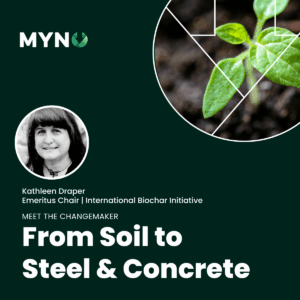
Where does biochar create economic advantage, not just carbon benefit? What materials or processes could biochar replace, rather than simply supplement?
When most people hear “biochar,” they think of farms, compost, or soil amendments. But a quiet shift is underway, one that sees biochar not as a niche agricultural input, but as a versatile material for industrial-scale climate solutions. From cement to energy infrastructure to road construction, biochar is beginning to show promise far beyond the field. And if its potential is realised, it could become one of the most pragmatic and underestimated tools in the carbon removal toolbox.
“Biochar is where petrochemicals were 100 years ago,” says Kathleen Draper, Emeritus Board Chair of the International Biochar Initiative. “Biochar isn’t just about what it locks away, it’s about what it can replace.”
This evolution is sometimes described in three stages:
- Biochar 1.0: Soil health and agriculture
- Biochar 2.0: Carbon credits and sequestration
- Biochar 3.0: Engineered, performance-based materials for industrial use
In this article, we explore three emerging use cases where biochar is beginning to shift from waste byproduct to climate infrastructure.

Biochar in cement: From sequestration to substitution
Concrete production is responsible for an estimated 8% of global CO₂ emissions. Finding ways to decarbonise it is urgent and biochar is starting to play a role.
Companies such as Holcim (Switzerland) are already incorporating biochar into their ready-mix concrete. Biochar can act as a partial cement substitute or as an aggregate substitute, helping reduce the embodied carbon of the final material while offering added benefits such as reduced cracking & shrinkage, increased durability, insulation and water adsorption during curing and it is lighter weight making transportation and handling easier.
“The challenge isn’t just making it work technically; it’s making it work economically and consistently at scale,” Draper says. “Material properties, carbon accounting, and regulatory frameworks like Environmental Product Declarations (EPDs) all need to align.”
There are open questions around credit allocation (who gets to claim the carbon benefit?) and feedstock variability, but the early signals are promising. Pilot data show that concrete mixes with well-formulated biochar can retain or even improve performance, while cutting carbon.
Biochar as thermal backfill in pipeline and energy infrastructure
An unexpected but increasingly relevant application for biochar is beneath our feet: pipeline infrastructure.
Natural gas and oil pipelines stretch for millions of miles worldwide. They often require thermal backfill, a material that surrounds pipes to regulate temperature and prevent stress cracking. Biochar’s low thermal conductivity, high adsorption properties and environmental safety make it an intriguing candidate.
“I’ve spoken to researchers and utility leaders about using biochar as a kind of insurance layer,” says Draper. “It could regulate heat, and potentially buffer methane or CO₂ leaks, and support future undergrounding efforts of electrical cables. It could even play a role in the emerging carbon capture pipeline build-out.”
She points out that using biochar during installation is likely easier than retrofitting. But as interest in direct air capture (DAC) pipelines grows and concerns about CO₂ leakage rise, biochar’s role as a safety layer may gain traction.
While field trials are needed in different soils and climatic conditions, this application taps into a vast industrial category with high regulatory visibility, making it a space to watch.
Biochar in asphalt and road surfaces: Decarbonising the drive ahead
The global road network spans more than 64 million kilometres and road construction is a major consumer of bitumen – a petroleum-derived binder with a high carbon footprint. Integrating biochar into asphalt offers a route to lower emissions while improving material performance.
Research shows that replacing 5-10% of asphalt binder with finely milled biochar can improve rutting resistance, fatigue life, and binder aging (Zhang et al., 2023). Biochar’s porous structure also supports ongoing CO₂ sequestration throughout the pavement’s life.
Beyond mechanical benefits, biochar can help address urban heat island effects. When incorporated into lighter-coloured asphalt mixes, it can reduce surface temperatures, contributing to cooler urban environments.
Europe has seen pilot projects combining biochar with renewable oil-based binders to create low-temperature, electrically cured cycle paths. These reduce installation energy demands and eliminate the need for fossil-fuel-heated asphalt plants (Biochar Zero, 2024).
If scaled, this approach could enable municipalities, highway authorities, and infrastructure contractors to deliver lower-carbon roads without sacrificing performance, aligning with both sustainability goals and durability requirements.
“As with biochar infused concrete, bio-asphalt offers more than just carbon sequestration,” says Draper. “Biochar asphalt has been shown to improve heat and rutting resistance leading to more durable infrastructure. It also reduces VOCs making road construction less hazardous to construction workers”
Why these use cases matter now
As global pressure mounts to scale carbon removal, skepticism is also rising. Many critics dismiss anything that doesn’t lock carbon away for 1,000 years. But Draper challenges this thinking:
“We don’t have the luxury of waiting for perfect permanence. We need solutions that work at the decade scale, that pull carbon from the short-term cycle today.”
That perspective is gaining traction among policymakers and innovators alike. Biochar’s unique strength lies in doing multiple jobs at once: reducing emissions, improving materials, and regenerating ecosystems.
What’s needed now is integration: bringing engineers, builders, utilities and land managers to the table with biochar scientists and producers. The sooner we expand the frame, the faster we scale the impact.
Blog Highlights
Where does biochar create real commercial upside?
Biochar’s upside lies in its ability to enter large, existing industrial markets, such as cement, roads, and energy infrastructure, by replacing higher-emission materials while improving performance. This positions biochar not as a niche climate product, but as a functional input into trillion-dollar supply chains with repeat, infrastructure-scale demand.
What differentiates engineered biochar from commodity biochar?
Engineered biochar is designed for predictable performance, consistency, and certification—qualities required for infrastructure and industrial adoption. This enables pricing based on material value and risk reduction, not just carbon credits, creating defensibility through formulation, process control, and integration into regulated markets.
What are the key signals that biochar can scale economically?
Early pilots show biochar can meet or improve material performance while lowering embodied carbon and, in some cases, lifecycle costs. As standards, EPD inclusion, and procurement frameworks mature, biochar is positioned to scale through existing construction and infrastructure workflows rather than building entirely new markets.
About the Authors
Kathleen Draper is Emeritus Board Chair of the International Biochar Initiative and U.S. Director at the Ithaka Institute. She is the author of the forthcoming book “Dwelling on Drawdown,” and a global advocate for engineered biochar as a systems-level climate solution.
Myno Carbon is a U.S.-based company pioneering Biochar 3.0 – engineered formulations for carbon-negative remediation and infrastructure. Learn more at mynocarbon.com.