

From Lab Curiosity to Field-Scale Remediation
March, 2026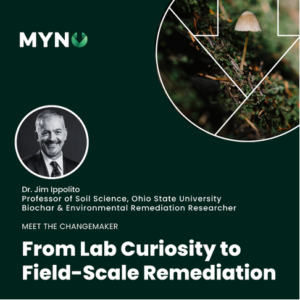
How can biochar move beyond laboratory studies to become a scalable solution for heavy metal contamination? Dr. Jim Ippolito examines the science behind biochar’s ability to bind metals like lead, zinc, and nickel; including what it will take to deploy it across real-world remediation sites.
When it comes to land degradation, few challenges are as stubborn, or as widespread, as heavy metal contamination. Mining districts, industrial sites and abandoned tailings around the world continue to leach toxic metals into soils and waterways, threatening ecosystems and human health.
The standard playbook for managing these sites with lime additions, capping, or excavation is often expensive, temporary, or disruptive. Into this space, biochar has emerged as an intriguing alternative. Produced by heating biomass under low-oxygen conditions, biochar has a unique combination of properties: high surface area, functional groups that attract positively charged ions, and the ability to persist in soils for decades or more.
“I’ve worked in reclamation sites across Colorado, Missouri, Oregon, and beyond,” says Dr. Jim Ippolito, Professor of Soil Science now at The Ohio State University. “Again and again, I’ve seen that biochar loves to hold onto metals like lead, zinc, and nickel. The question is, how do we scale that promise from small plots to whole landscapes?”
Why Heavy Metals Matter
Heavy metals pose a dual threat. In soils and at relatively great concentrations, they inhibit plant growth and microbial activity, leaving bare ground vulnerable to erosion. In water, they move downstream, contaminating drinking supplies and aquatic ecosystems. Lead exposure alone is linked to severe health risks, particularly in children, while cadmium and nickel are associated with kidney and liver toxicity.
Remediation is not optional. Yet many conventional approaches are stopgaps. Lime, for instance, can temporarily neutralize acidic mine tailings but does little to prevent metals from mobilizing again if not applied properly. Granular activated carbon (GAC) is used in water treatment but is costly at the scale needed for soils.
This is where biochar presents a systems-level opportunity: it is carbon-rich, widely producible from local waste streams and, when properly engineered, capable of immobilizing toxic metals.
What the Science Shows
Jim has spent nearly two decades exploring these mechanisms. His research and meta-analyses show a consistent pattern: most biochars can sorb heavy metals, but performance varies widely depending on feedstock and pyrolysis conditions.
- Lead, zinc, nickel: Many biochars, particularly wood-based or high-temperature chars, strongly immobilize these cationic metals. Once adsorbed, they are less likely to leach back into the environment.
- Cadmium: The outlier. Cadmium can sorb initially but often desorbs later, making it a persistent challenge. “Cadmium is the million-dollar question,” Jim says. “We need biochars that can hold it without re-releasing it.”
Temperature is critical. Increasing pyrolysis temperatures from 300°C to 700°C improves sorption capacity. In one case, gasified products created at 1,100–1,400°C outperformed GAC in sequestering cadmium, copper, nickel and zinc and without releasing them back into solution.
“These results were exciting,” Jim explains. “They showed us that some biochars aren’t just alternatives to activated carbon. In some cases, they can be better.”
From pilot plots to field scale
Laboratory and greenhouse results are only part of the story. For Jim, the real test comes in the field. “Scientists like me tend to work at small scales,” he says. “But reclamation demands solutions that work across acres, not test plots.”
A successful field trial, in his view, requires more than just adding biochar:
- Rate studies to determine the optimal application levels.
- Amendment combinations (biochar with compost, manure, or lime) to address nutrient deficiencies and acidity.
- Revegetation strategies using native and early successional species to stabilize soils and prevent erosion.
He has seen this approach in action at sites in Oregon and Missouri, where biochar-amendment mixes improved soil cover, reduced metal mobility and set the stage for long-term recovery.
Yet too many projects remain stuck in what he calls Pilot Purgatory. “We have proof of concept,” Jim says. “Now we need the courage and the partnerships to go bigger.”
Unlocking the next wave
If the science is promising, why hasn’t biochar become a mainstream remediation tool? Jim points to several barriers:
- Regulatory hesitation: Agencies worry about unintended consequences and often require long-term data before approving new methods.
- Economics: Sourcing and transporting enough biochar for large-scale sites is costly, especially when local production is limited.
- Disconnects: Industry and academia often operate in silos, with research findings not translating into field deployment.
Closing these gaps requires deliberate collaboration. Jim envisions industry-academia partnerships where scientists provide screening tools to identify effective biochars and companies test them at scale. “It’s not about more 10-by-10-foot plots,” he says. “It’s about fixing landscapes.”
Looking Ahead
Heavy metal contamination is not going away. Global mining legacies stretch across thousands of square miles, from the Tri-State District in Missouri to coal regions in China. Traditional remediation methods will remain part of the toolbox, but biochar offers a sustainable, carbon-negative complement, one that immobilizes metals, builds soil function and sequesters carbon in the process.
“The potential is there,” Jim concludes. “We just need to stop tinkering and start doing. Biochar has already proven it can work. The next step is to put it to work where it’s needed most.”
About the Authors
Dr. Jim Ippolito is the Rattan Lal Endowed Professor of Soil Health and Fertility at The Ohio State University with expertise in soil chemistry, mine reclamation, and environmental remediation. He has published extensively on biochar’s role in heavy metal sequestration and is currently advancing research into PFAS-contaminated soils.
Myno Carbon is a U.S.-based company pioneering Biochar 3.0 – engineered formulations for carbon-negative remediation and infrastructure. Learn more at mynocarbon.com.
Blog Highlights
How does biochar help immobilize heavy metals in soil?
Biochar’s high surface area and functional groups allow it to adsorb positively charged metal ions such as lead, zinc, and nickel, reducing their mobility and limiting their ability to leach into groundwater or be taken up by plants?
Which heavy metals can biochar effectively capture?
Research shows biochar can strongly immobilize metals like lead, zinc, and nickel. Some metals, such as cadmium, are more challenging and may require engineered biochars or higher-temperature pyrolysis processes to improve long-term retention.
Can biochar replace traditional remediation methods like lime or activated carbon?
Biochar is not always a complete replacement but can serve as a powerful complementary solution. When combined with other amendments such as compost, lime, or revegetation strategies, biochar can enhance soil health while stabilizing contaminants.
How are engineered biochars improving remediation outcomes for contaminated soils?
Not all biochars perform the same. Advances in feedstock selection and pyrolysis conditions are enabling the development of engineered biochars designed to maximize metal adsorption and long-term stability. Companies like Myno Carbon are working to translate laboratory research into scalable remediation solutions that immobilize contaminants while restoring soil health and sequestering carbon.