





Biochar for Groundwater Contamination
Free-phase and residual petroleum contamination in soil and groundwater can act as a continuing source of dissolved hydrocarbons. Left untreated, it can drive contaminant migration, extend monitoring requirements, and create long-term environmental and financial risk.
Myno Carbon’s engineered biochars are delivered in liquid form and injected into the source area and downgradient locations to manage plume migration and accelerate degradation rates. These products enhance natural attenuation via bioremediation by stimulating the growth of beneficial microorganisms to break down petroleum hydrocarbons—while helping reduce contaminant mobility via adsorption.
Turn the Source Area Into an Active Treatment Zone
Traditional source area management can require years of recovery, treatment and monitoring. Residual petroleum contamination can continue releasing dissolved hydrocarbons and contribute to plume migration over time.
In-Situ Remediation
Engineered biochar can be applied within the contaminated zone to stimulate microbial degradation, reduce contaminant mobility and migration, and support treatment of residual petroleum contamination.
Durable & Sustainable Treatment
Biochar provides a durable treatment medium that remains in place while improving project sustainability metrics and storing durable carbon within the treatment zone.
Value Across Groundwater Remediation Stakeholders
Responsible-Party Site Managers
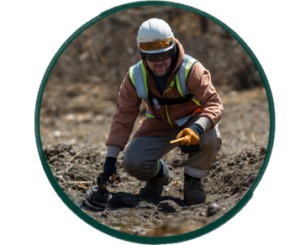
Reduce Site Risks & Treatment Time
Reduce Long-Term Site Risk
- Address petroleum contamination at the source
- Reduce long-term environmental risk
- Limit contaminant migration
- Support regulatory risk management
Reduce Long-Term Treatment Burden
- Shorten treatment timelines
- Reduce long-term monitoring
- Lower lifecycle remediation costs
- Minimize disruptive site activity
Create a Clearer Path to Closure:
- Improve predictability of site outcomes
- Reduce long-term remediation uncertainty Improve remedy sustainability
Engineering Company Project Managers

Incorporate engineered biochar into site-specific remediation designs
Enhance Petroleum Hydrocarbon Biodegradation:
- Promotes petroleum-degrading microorganisms
- Supports biological degradation
Improve Source Zone Treatment:
- Targets residual petroleum contamination
- Supports long-term treatment
Reduce Dissolved Contaminant Migration:
- Sorbs petroleum hydrocarbons
- Reduces contaminant mobility
- Limits migration from the source zone
Integrate With Existing Remedies:
- Complements existing remedial systems
- Supports technical performance
- Advances sustainability objectives
Key Features
Supports Biodegradation
Biochar’s porous structure provides habitat and promotes growth of larger populations of petroleum-degrading microorganisms than can be achieved in most native soils.
Reduces Contaminant Migration
Biochar’s porous structure provides habitat and promotes growth of larger populations of petroleum-degrading microorganisms than can be achieved in most native soils.
Extends Treatment Performance
Biochar remains in place, providing a durable treatment medium that can continue supporting biological activity over time.
Complements Existing Remedies
Biochar can be integrated with technologies such as free-product recovery, enhanced bioremediation, monitored natural attenuation and groundwater treatment systems.
Targeted Groundwater Remediation
Source Zone Treatment
Integrate within remediation strategies to manage source contamination.
Downgradient Plume Management
Apply engineered biochar at downgradient locations to reduce contaminant migration.
Residual Contamination
Treat residual hydrocarbons contributing to groundwater contamination.
Integrated Remediation
Combine biochar with existing remediation and treatment systems.
Is Source Zone Bioremediation Right for Your Site?
Myno Carbon can work with your team and engineering partner to evaluate how engineered biochar could support your remediation strategy.
FAQs
How does biochar work for petroleum-contaminated groundwater?
Biochar can support the remediation of petroleum-contaminated groundwater by providing a highly porous, carbon-rich medium that helps adsorb petroleum hydrocarbons and reduce their mobility. Its porous structure can also provide habitat for naturally occurring microorganisms that contribute to biodegradation. Together, these mechanisms can help contain contaminants within the treatment zone while supporting their ongoing biological degradation.
How is liquid biochar applied to groundwater?
Liquid biochar formulations can be introduced into the subsurface through injection wells or other site-appropriate delivery methods, allowing the biochar to reach targeted areas of contaminated soil and groundwater. Once distributed within the treatment zone, the biochar can interact with contaminants and support conditions favorable to longer-term remediation. Application methods are tailored to site geology, hydrogeology, contaminant distribution, and remediation objectives.
What is source zone bioremediation?
Source zone bioremediation targets areas where petroleum contamination is concentrated in the subsurface rather than focusing only on the groundwater plume that has migrated away from the source. The goal is to stimulate or support naturally occurring microorganisms that can break down petroleum hydrocarbons. Biochar can be incorporated into a source-zone treatment strategy to help retain contaminants within the treatment area while providing a supportive environment for microbial activity and biodegradation.
How does biochar help reduce plume migration?
Biochar can help reduce plume migration by adsorbing dissolved petroleum hydrocarbons onto its porous carbon structure, which can reduce contaminant mobility and limit their movement with groundwater. By retaining contaminants within the treatment zone, biochar can also increase the opportunity for naturally occurring microorganisms to degrade them over time. The result can be a more localized and manageable treatment area, depending on site conditions and contaminant characteristics.
Can biochar complement an existing groundwater remediation system?
Yes. Biochar can potentially be incorporated into a broader remediation strategy alongside existing approaches such as pump-and-treat, monitored natural attenuation, bioremediation, or other in-situ technologies. For example, biochar may be used to target residual contamination or source areas while an existing system manages the broader groundwater plume. The appropriate combination depends on site conditions, treatment objectives, and the performance of the existing remedy.
How do you determine the appropriate biochar application rate?
The appropriate application rate is site-specific and should be based on factors such as contaminant type and concentration, treatment-zone dimensions, groundwater conditions, soil characteristics, hydrogeology, and remediation objectives. Laboratory testing, site characterization, treatability studies, and/or field pilot testing can help determine an appropriate formulation, concentration, and application strategy before full-scale implementation. This site-specific approach helps ensure that biochar is applied where and at the levels needed to support the desired remediation outcomes.