
BP’s Remediation Management Services Company Selects Myno Carbon for Landfarming Remediation Trial
October, 2026Evaluating Enhanced Liquid Biochar for Hydrocarbon-Contaminated Soil Recovery
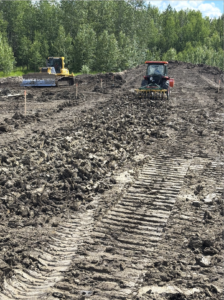
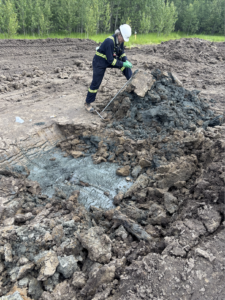
BAINBRIDGE ISLAND, Wash., Oct. 7, 2026 / PRNewswire/ – Myno Carbon is proud to announce its participation in a landfarming remediation trial with BP Remediation Management Services Company (BP RM), supplying its enhanced liquid biochar to remediate weathered petroleum hydrocarbons associated with an historic well blowout.
The multi-year trial, which began in mid-2025, is examining how engineered biochar can support the remediation of hydrocarbon-impacted soils through a combination of contaminant sorption and enhanced biological degradation. Early observations indicate that Myno’s liquid biochar is performing well, supporting continued evaluation throughout the study.

BP RM’s decision to include Myno Carbon in this pilot reflects growing interest within the energy industry in remediation technologies that not only address contamination but also support long-term soil recovery and biostimulation as well as sustainability goals.
Petroleum contamination remains one of the largest environmental challenges facing society. Thousands of acres, impacted by the activities of tens of thousands of different operators in North America, continue to undergo remediation, often requiring years or decades to achieve cleanup objectives. As modern operators seek more sustainable and effective solutions, biochar is emerging as a promising tool for accelerating remediation while improving soil health and potentially reducing remediation timelines by decades.
For Myno Carbon, the opportunity extends beyond treating contaminated soil. The company’s enhanced biochar technology is designed to work through two complementary mechanisms: rapidly adsorbing hydrocarbons while simultaneously creating favorable conditions for hydrocarbon-degrading microorganisms.
The result is a remediation approach that aims to both manage contamination and support the natural biological processes responsible for long-term recovery.
Why Biochar Matters in Hydrocarbon Remediation
Traditional landfarming approaches rely primarily on naturally occurring microorganisms to break down petroleum hydrocarbons over time. While these biological processes can be effective, remediation timelines can extend for years, particularly when dealing with weathered contaminants that have become tightly bound to soil particles.
Biochar offers a different approach. By combining contaminant adsorption with biological support, engineered biochar can help remediate hydrocarbons contamination through multiple pathways simultaneously.
Myno’s enhanced liquid biochar is designed to provide two complementary functions:
- Adsorption of petroleum hydrocarbons and associated contaminants.
- Creation of favorable conditions for hydrocarbon-degrading microorganisms.
This dual-action mechanism allows contaminants to be captured while supporting the microbial activity responsible for accelerated degradation. For sites impacted by hydrocarbon contamination, this approach offers the potential to improve remediation performance while helping restore healthy soil functions.
What Makes Myno’s Enhanced Biochar Different
Not all biochars are created equally.
Most commercially available biochars are produced at temperatures between 300°C and 500°C. Myno’s enhanced biochar is produced at approximately 900°C to 950°C, creating significantly greater surface area and porosity.
This high-temperature production process delivers several advantages:
- Increased adsorption capacity for hydrocarbons and persistent organic contaminants.
- Greater pore volume for microbial colonization and growth.
- Improved durability and long-term performance in soil environments.
Published studies have demonstrated that similarly produced high-temperature biochars can strongly adsorb polycyclic aromatic hydrocarbons (PAHs) and other petroleum-related contaminants, in some cases performing comparably to activated carbon technologies.
These characteristics make enhanced biochar particularly well suited for challenging hydrocarbon-contaminated environments.
Why Liquid Biochar Improves Field Performance
Myno’s liquid formulation provides another important advantage.
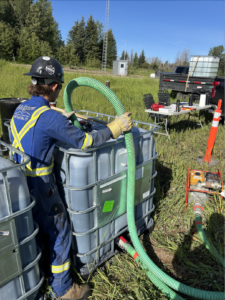
Micronized biochar particles offer substantially greater surface area than traditional granular products, allowing contaminants to come into contact with adsorption sites more quickly. The smaller particle size also enables more uniform distribution throughout treated soils.
Liquid application provides practical field benefits, including:
- More consistent application across treatment areas.
- Improved mixing within landfarming operations.
- Reduced dust during application.
- Better contact between biochar, contaminants, and microbial communities.
- Compatibility with existing remediation equipment.
By improving distribution and accessibility, liquid biochar helps maximize the interaction between the biochar and the contaminated soil.
Beyond Remediation: Supporting Soil Regeneration
One of the unique aspects of biochar is that its benefits extend beyond contaminant management.
Biochar can improve important soil properties that support long-term ecosystem recovery, including:
- Increased water-holding capacity.
- Improved nutrient retention.
- Enhanced cation exchange capacity.
- Greater pH stability.
- Support for microbial activity and nutrient cycling.
Wood-based biochar also provides a highly porous structure rich in carbon that serves as a favorable habitat for hydrocarbon-degrading microorganisms. These microbial communities play an essential role in breaking down petroleum contaminants over time.
“As we address contaminated soils, we have an opportunity to do more than simply manage pollution,” said Thor Kallestad, CEO of Myno Carbon. “By combining remediation with soil regeneration, we can help restore ecosystems, improve land productivity, and create lasting environmental benefits.”
Looking Ahead
The ongoing landfarming trial represents an important opportunity to evaluate how enhanced liquid biochar can contribute to the remediation of hydrocarbon-impacted soils.
As energy companies, remediation contractors, and engineering firms seek solutions that improve environmental outcomes while supporting sustainability objectives, biochar is emerging as a valuable addition to the remediation toolbox.
The combination of contaminant adsorption, biological support, and soil regeneration offers the potential to address not only today’s contamination challenges, but also the long-term recovery of the land itself.
For organizations evaluating more sustainable approaches to petroleum-contaminated soils, engineered biochar may provide a pathway toward faster recovery, healthier soils, and more resilient landscapes.
Link to the full Press Release here
Interested in learning how enhanced liquid biochar can support your remediation projects? Contact Myno Carbon at info@mynocarbon.com to discuss applications for hydrocarbon-contaminated sites and sustainable soil recovery strategies.